The ACT is now the most expensive place in Australia to build a detached house, and soaring costs are pushing developers toward apartments and narrowing housing choice, Primara Research warns.
Housing groups differ over whether government charges or broader structural cost pressures are most to blame.
New research by Primara, commissioned by HomeLoanRates.com.au, found that the ACT has become the first jurisdiction where the average cost of building a house passed $600,000 in 2025: it now sits at $645,052. The national average is $474,939.
The ACT’s build costs have risen $190,000 in the last three years, and are 36 per cent above the national average, approaching the gap between ACT and Australian build costs last seen during the COVID construction crunch, Primara says.
House building costs rose 14.4 per cent last year, more than double the Australian average, while new house commencements fell 59 per cent.
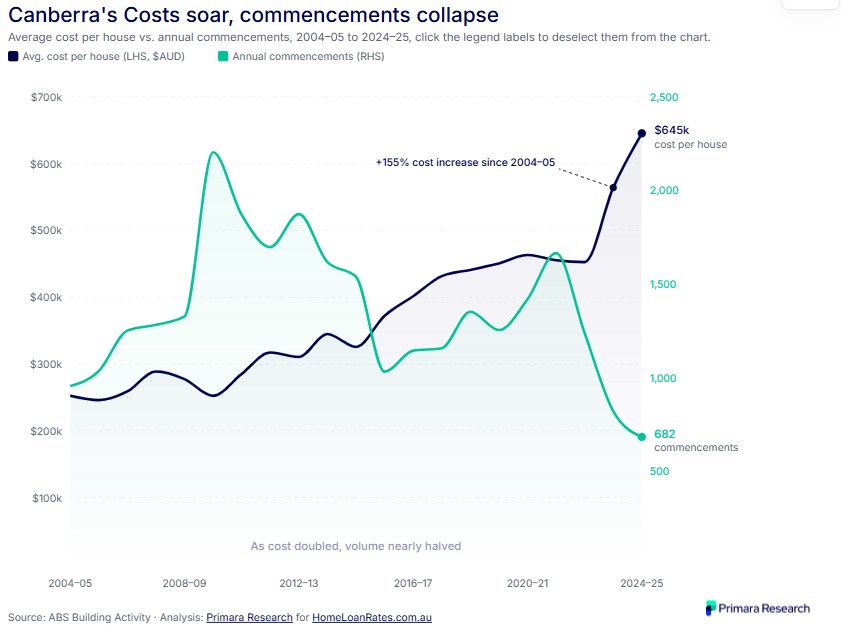
Primara says that since the ACT became the most expensive jurisdiction in which to build a house in 2016–17, commencements have fallen 40 per cent, approvals 33 per cent, and completions 16 per cent. The steepest falls occurred in the last two years.
ACT house commencements now represent only 2 per cent of national starts — a share not seen since 2015 — and are losing ground despite lifting 15 per cent in 2025, trailing Australia’s 16 per cent national growth rate.
Primara said apartments have risen to record levels: there were more commencements in the September 2025 quarter than in any quarter since 2018. Houses, which represented 31 per cent of ACT commencements in 2022, now account for only 19 per cent.
“The market is responding exactly as you’d expect,” Peter Drennan, Primara’s head of research and data, said. “Houses are becoming a rarity in the ACT. Developers are shifting to apartments where returns per square metre make the numbers work. For buyers who want a house, scarcity is only going to increase.
“With no regional or rural land to absorb demand, the ACT’s entirely urban footprint structurally inflates costs in ways other states can offset.”
Master Builders ACT noted, however, that Canberra houses were generally larger: the floor area is 298.1 sqm on average, compared to 241.5 sqm nationally. On a per square metre basis, the cost in the ACT is $2,163, which, while above the national average, ranks fourth behind Tasmania, NSW, and the Northern Territory. The cost per sqm has climbed 25.8 per cent over the past two years and 39.4 per cent over the last decade.
“This rising cost is contributing to a significant decline in new house commitments, pushing many developers towards apartment builds,” CEO Anna Neelagama said.
Ms Neelagama said new home building in the ACT was lagging, and that high costs were a barrier to delivery.
“Our industry continues to carry the weight of outdated planning systems, mounting red tape, chronic skills shortages, and growing regulatory burdens.”
The Property Council ACT and Capital Region also believed that land supply, taxation, and regulatory costs were making detached housing harder to deliver.
“Housing supply in the ACT is shaped by what land is released,” executive director Ashlee Berry said. “Right now, most of that land is zoned for medium‑density outcomes which makes it even harder for detached housing to compete on cost.
“When you combine rising build costs with high government charges and constrained land supply, the market response is predictable. Developers aren’t choosing apartments out of preference – they’re choosing what’s viable.”
Master Builders ACT has called on government to fast-track reforms that cut red tape and boost housing supply; place on hold any non-essential new regulatory reform; and relieve pressure on building and construction businesses.
Likewise, the Property Council believes a review of the Lease Variation Charge — which a Legislative Assembly called for last week — “can’t happen soon enough.”
“High taxes, charges and regulatory complexity are compounded in the ACT – particularly the Lease Variation Charge – and every extra layer of red tape is baked straight into the final build cost,” Ms Berry said.
However, ACT Shelter CEO Corinne Dobson warned against weakening the Lease Variation Charge, arguing that it would not solve the underlying causes of higher costs.
“It would simply forgo a fair return of planning value to the community at a time when it is most needed to invest in housing for those locked out. We need to stay focused on structural solutions that support delivery at scale, not short-term concessions that shift value without lowering costs.”
Ms Dobson said rising construction costs are a serious and growing threat, particularly to social and affordable housing projects.
“There is a clear role for government to step in and keep these essential developments moving,” Ms Dobson said. “But these pressures are structural, driven by material costs, labour constraints and global supply disruptions, and are being further intensified by instability in the Middle East.”