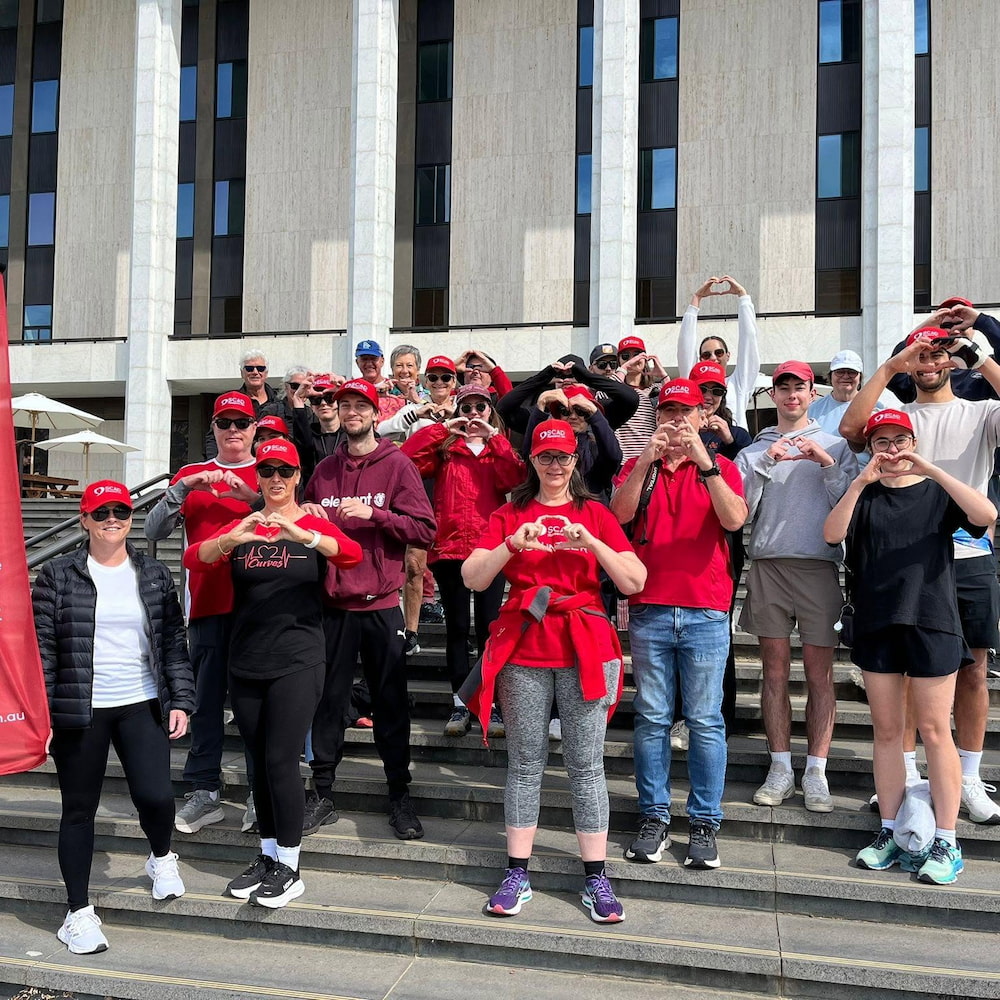
This Sunday, a community walk, the SCADaddle, will be held to raise funds for lifesaving research into spontaneous coronary artery dissection (SCAD), an uncommon heart condition that predominantly affects women.
The SCADaddle for Research begins at the National Library at 10am. The 5 km walk will take one hour to walk. Forty Canberrans are already registered to attend, joining hundreds at SCADaddles across the country.
The event, run by SCAD Research Inc., will raise funds for the Victor Chang Cardiac Research Institute, leading Australia’s first and largest research program into SCAD.
Although heart disease kills almost twice as many women as breast cancer each year, funding for heart research does not match those trends, organisers say.
“Driven by survivors, we’re on a mission to help fund this ground-breaking Australian research to reduce the risk of SCAD for our children and grandchildren and give survivors hope,” Sarah Ford, founder of SCAD Research Inc., said.
SCAD occurs when a blood vessel in the heart tears, slowing or blocking blood flow to the heart, and causing heart attacks, abnormal heart rhythms, or even sudden death.
SCAD is the #1 cause of a heart attack in women under age 50, and a major cause of sudden heart attack in healthy, fit adults, organisers say. 70 per cent of cases occur in people under 50 – the average age is 42 – and 90 per cent of cases occur in women.
Those most at risk are women after pregnancy or during menopause – “the two most significant times of hormone change in women,” SCADaddle Canberra organiser Joanne Chilver says.
Many who suffer SCADs are fit and healthy, or have no known risk factors for heart disease – and the underlying cause is often unknown.
In recent years, however, the Victor Chang Cardiac Research Institute has discovered 16 genes associated with SCAD.
“We are finally starting to understand its triggers,” Professor Jason Kovacic, the facility’s director and CEO, said.
Many health workers have never heard of SCAD, Moonbi Taylor, who suffered SCAD in her early fifties, said.
“Most of us, when we fronted up to our GPs for the first time after our SCAD, they were like, ‘Yes, I haven’t heard of that.’”
Too often, SCADs are dismissed as panic attacks. When ex-Olympian Libby Trickett had her SCAD two months after giving birth, doctors told her symptoms were anxiety; she went eight months without knowing that she had suffered a heart attack.
The symptoms of a heart attack in women are shortness of breath; pain in neck, jaw, shoulder, upper back, abdomen; chest pain (may feel like pressure or tightness); pain in one or both arms; nausea or vomiting; heart palpitations; breaking out in a cold sweat; light-headedness or dizziness; and unusual feelings of fatigue. Anyone experiencing those symptoms should call Triple Zero (000) immediately.
“You might be having a heart attack,” Linda Ryan said. “Don’t discount that because you’ve associated heart attack with coronary artery disease, and you think you’re too young.”
She experienced her SCAD in her mid-fifties. She was out with her husband buying a lawnmower, and thought at first she had pulled a muscle; CALMS told her to go to the hospital emergency department.
“You feel like your body is a fifth columnist,” Ms Ryan said. “The emotional impact is severe because it makes you feel very mortal – it makes you feel very unsure of your body.”
She said she feared she would be dead within months, but her cardiologist assured her that her condition could be managed for 30 to 40 years.
SCADs are life-altering, Ms Chilver says. She had to leave her job as a primary school teacher after suffering two SCADS, and now works casually.
“The shock is huge,” Ms Chilver said. “I would have expected if I’m going to end up in hospital, it’s because I’ve broken something – not your body has let you down.”
After a SCAD, patients need to rest for several weeks while the artery heals, Ms Taylor said: they might have to avoid even everyday activities like laundry or lifting children.
Some doctors advise patients to avoid strenuous exercise indefinitely. Ms Chilver, for instance, gave up running, while Sarah Ford could no longer play netball after suffering her first attack on the courts.
SCAD sufferers are often treated as for heart disease; rehab, Ms Ryan says, is focused on “old guys who basically need to exercise more”.
“They have stents and they’re feeling great because their heart has opened up,” Ms Chilver said. “They’re feeling better than they’ve been feeling for 10 years. They start exercising and they change their lifestyle. Whereas we went from being fit and healthy to now thinking we’re going to die tomorrow, so we’re not feeling great.”
To take part in the SCADaddle, or donate to research, visit the SCAD Research Inc. website: https://scadaddle.raiselysite.com/